Idiomas // Languages // des langues // Sprachen // 語言 //

Showing posts with label Lebanon. Show all posts

BLC Headquarters by Atelier Hapsitus

BLC Landmark by Hapsitus Architects
Lebanon architects Atelier Hapsitus’s proposed design for the new headquarters of the BLC bank in Beirut would cantilever over the existing building.
BLC Landmark by Hapsitus Architects
The existing BLC headquarters would be renovated and connect with the new building at basement level.
BLC Landmark by Hapsitus Architects
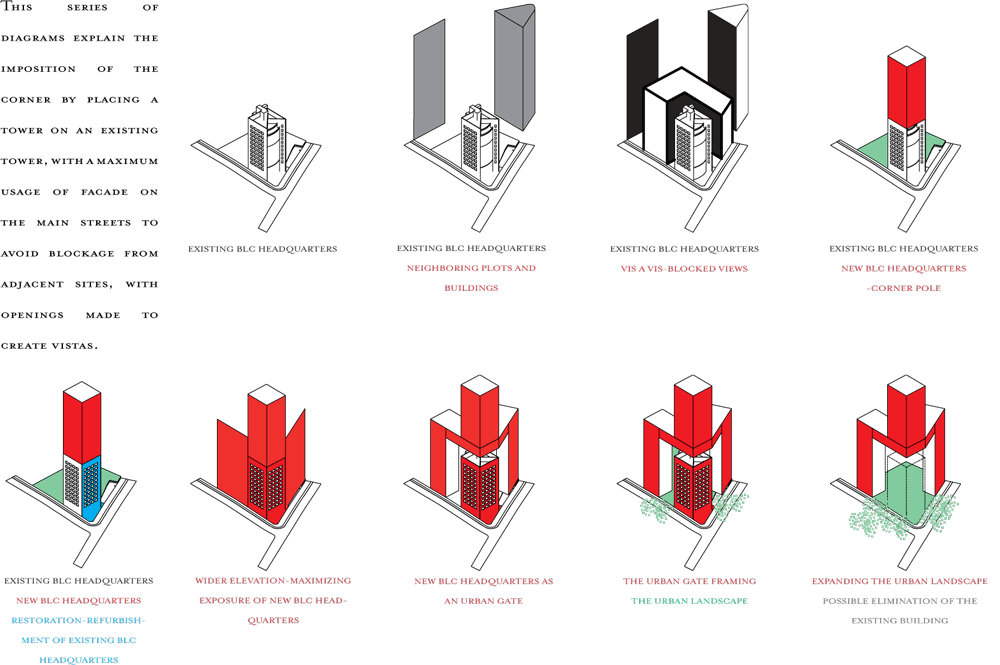
The gateway form of the new BLC headquarters would allow the existing building to retain its views and also eventually be removed.
BLC Landmark by Hapsitus Architects
The new building is supported on columns at first-storey level to leave plenty of civic space underneath.
BLC Landmark by Hapsitus Architects
The design is one of two schemes shortlisted for a final competition to be decided in two months.
Here’s some more from the architects:


Selected as co-finalist
The project consists of the creation of a landmark for the city of Beirut, extending the existing building without destroying it. We created a project whereupon the new structure shares the corner with the existing building and cantilevers above it.
BLC Landmark by Hapsitus Architects
The presence of the existing building at the corner of the site was an enigma to us. It had the key position on the site, although it was not necessarily the most appropriate image for the BLC new headquarters.
BLC Landmark by Hapsitus Architects
Above: The existing BLC building
In order to resolve this issue, we created a project whereupon the new structure shares the corner with the existing building and cantilevers above it. In this way, the different expressions of old and new become complementary, working together in symbiosis.
BLC Landmark by Hapsitus Architects
Our proposal for the BLC headquarters strives to reflect the history of the bank and project its future with a design strategy that responds intuitively to the site. Like the new administration of BLC, we have chosen to adopt the existing structure, streamline it, correct its dysfunctional aspects, and celebrate it as the departure point for a dynamic, sophisticated and unique composition growing around and above it.
BLC Landmark by Hapsitus Architects
We believe that BLC Bank is best represented by a project that opens itself visually to the urban fabric with alluring spaces and landscape, rather than the hermetic and alienating facades that often characterize large corporations. The streetscape we have conceived gives the image of a bank which is progressive, has a civil consciousness and offers a quality environment to clients and employees alike.
BLC Landmark by Hapsitus Architects
The design of the project is an unselfconscious gesture shaped by the site itself and the needs of the project. We toyed with forms and ideas until an intuitive, almost spontaneous shape imposed itself; a process which gives the design an edge of unconventionality.
BLC Landmark by Hapsitus Architects
The total project is an arresting visible landmark that thrusts the bank headquarters into the 21st century in all ways possible. It is innovative in design, in its integration of the existing building, in the way it addresses the site, in its use of sustainability, in forward-thinking social facilities, and in its bold structural solution which makes the design possible.
BLC Landmark by Hapsitus Architects
--> Read more...

The Landmark, Beirut, by Jean Nouvel

sq_sud.jpg
Architect Jean Nouvel has restarted work on The Landmark, a large mixed-use development in central Beirut, Lebanon.
sq_ouest.jpg
The project features a 42-storey tower containing a hotel and apartments a horizontal commercial and leisure block with a raised pedestrian street.
interieur-2.jpg
Nouvel won the project through an international competition in 2004 but the project was later put on hold. Nouvel has now revised his designs.

retail-entrance1.jpg
More information on the project’s website.
retail-entrance2.jpg
retail.jpg
photoaerienne.jpg
facade-nord.jpg
facade-sud.jpg
facade-ouest.jpg
facade-est.jpg
north.jpg
luxury1.jpg
hotel1.jpg
fitness-3.jpg
fitness-2.jpg
fitness-1.jpg
--> Read more...

Beirut Terraces by Herzog & de Meuron


Herzog & de Meuron Beirut Terraces
Swiss architects Herzog and de Meuron have designed this apartment tower with overhanging floor plates and terraces for Beirut, Lebanon.
Herzog & de Meuron Beirut Terraces
Created as part of a wider masterplan to regenerate this area of the city that includes a marina, the building will comprise five different modular floor slabs used in varying combinations to create a mixture of overhangs and terraces.
Herzog & de Meuron Beirut Terraces
The building will have vegetation on the terraces to provide privacy and in the main entrance space to act as continuation of the neighbouring green boulevard.
Herzog & de Meuron Beirut Terraces
The 116 metre-high structure will be supported by columns on a 14.7 metre regular grid, with each floor plate overhanging the glazing by at least 60 centimetres.
Beirut Terraces Herzog & de Meuron
129 single, duplex and townhouse apartments will be available, arranged in different clusters throughout the tower.
Herzog & de Meuron Beirut Terraces
The project is due for completion in 2013.
Herzog & de Meuron Beirut Terraces
See all our stories about Herzog & de Meuron »
All images © Herzog & de Meuron. More information on the project website.
Here’s some more from the architects:


Site
The city of Beirut finds itself at the heart of the developing Middle East. As a cosmopolitan city throughout its existence, it always figured as a cultural hub of the region and – culturally as well as geographically – functioned as a link between Europe and the Middle East. By consequence Beirut’s urban history could hardly be more diverse; remains of Phoenician, Roman, Arab, Mamluk, Ottoman and colonial rule have shaped the city and its buildings, just as its past and eventful present have left their mark.
The design of Beirut Terraces was quite literally influenced by the layers of the city’s rich and tumultuous history. The most immediate historical event, which those from Beirut will remember for generations to come, is that of the assassination of the Prime Minister Rafiq Hariri, which occurred when his car detonated in front of the St.Georges Hotel, its ruins are still visible as a daily reminder. Adjacent to the site there is a vast landfill of war-debris and trash from the several bombings since the 1970’s, but in the future this will change. Despite the scarred history, there is a clear vision to rehabilitate the area, the current masterplan already well under way aims to rebuild and bring life back to this part of Beirut. The site is located in a portion of the masterplan dedicated to building office and residential high rise buildings and is closely related to a new yachting marina.
Beirut Terraces by Herzog & de Meuron
Above: level three
Architecture
The proposed building concept, structure, and appearance are conceived by both awareness and respect for the city, as well as self-confident optimism that it shares with contemporary Beirut. The project is founded on five principles: layers and terraces, inside and outside, vegetation, views and privacy, light and identity. The result is a vertically layered building expressed by diverse sizes of slabs which create both openness and privacy and enable flexible living between in- and outside. Fine detailing and a focus on the concerted orchestration of decent materials make for an efficient and luxurious building. Conscious of energy use, the environmental engineering coupled with the integration of vegetation into the architecture, enhance the quality of living while also lending to the building’s sustainability.
Beirut Terraces by Herzog & de Meuron
Above: level 9
Layers and Terraces
The building is a 116 meter tall multilayered high rise. Its stratified structure is differentiated by the individual residences set back or forward to allow for terraces and overhangs, light and shadow, and places of shelter and exposure. In this way unique places are created to be enjoyed by residents and guests alike. The individual apartments are grouped on the different levels in different formations and come together to carefully shape a new neighbourhood.
Inside and Outside
The moderate climate of Beirut is certainly one of the city’s biggest assets; it makes outdoor life not only an additional, but an integral part of Beirut’s urban life. Capitalizing on this asset and cultivating apartments that foster such specificities is one of the key design principles. Each apartment’s indoor and outdoor spaces merge, and in this way the terraces become integral to everyday living.
Vegetation, Views and Privacy
The proposal for the vegetation blends in with the concept of the existing masterplan. The idea of a green boulevard that connects the residential high rise to its surroundings is taken up by the design and continued vertically both inside and outside of the building. The main entry, an airy high space is equipped with water ponds, plants and outlooks that open up the views to the sea in the north and the green boulevard to the east. The complement between architecture and suspended nature enlivens the spacious lobby around the central core and continues up to the balconies and terraces throughout the entire building. The entry sequence thus develops a consistent transition between the open, public landscape and private, green residences.
Being almost on the shoreline of Beirut, the sea-views are precious qualities of the project. Throughout the building’s terraces plantings create vegetated screens, which simultaneously provide shade, but, more importantly, guarantee the necessary level of privacy between the individual apartment’s terraces. Additionally, the building’s vegetation frames views and generates pleasant microclimates by tempering their immediate environment and providing an active breathing part of the architecture.
Beirut Terraces by Herzog & de Meuron
Above: level 20
Light and Identity
Extensive overhangs provide shadow and reduce the solar gains of the building to a minimum. Wherever needed, perforations mediate the levels of light and solar exposure. Their density, shape, and shadows generate an unmistakable pattern that clearly distinguishes the identity of the tower from its surroundings. Furthermore, the relative thickness of the floor plates is substantial enough to balance the daily temperature cycles by virtue of its thermal mass, storing heat over the course of the day and releasing it during the cooler nights. It is such passive strategies that make the building a truly sustainable place to live.
Structure
To guarantee sufficient differentiation of the building volume and maintain a reasonable building ratio, the tower is made from five module floors that repeat in different combinations. The slabs of each floor protrude around their entire circumference by 60 centimetres, easing construction and maintenance of the extensive glass façades. The structure is carried by the core and a regular column-grid that spans up to 14.7 meters. Each quarter of the tower has its own lobby with elevators serving no more than two apartments at a time. For higher efficiency two lobbies share service elevators, MEP risers, and fire escapes.
Apartments
The mix of apartments of different sizes and types such as simplex, duplex and townhouses with pools are distributed throughout the building to offer a variety of conditions to meet each tenant’s needs and provide each apartment with a unique identity. The apartments generally consist of three areas: a reception, private living spaces, and a service area. The reception opens to a foyer and leads to a grand living room with a spacious area for entertaining, a dining area, and a generous viewing terrace. The private space features a family living room and bedrooms including en-suite bathrooms and walk-in closets. The service area includes a kitchen with storage and laundry room attached and a maid’s bedroom with bathroom. All the main spaces like living rooms and bedrooms consistently provide a generous clear height of 3.4 meters.
Beirut Terraces by Herzog & de Meuron
Above: level 25
Amenities
Beirut Terraces provides the residents with amenities at the entry level such as a generous spa with pool, sauna, steam and massage rooms and shopping facilities along the boulevard.
Parking
Parking is fully split between visitors and residents. The visitors enter by car from north, while the residents’ cars enter through the main gate to the south. Upon entering they first drop off their passengers, and then use the ramps that flank the circular driveway to descend directly to the restricted lower levels. When leaving the building the passengers are picked up in front of the main lobby and exit through the gate.
Project Name: Beirut Terraces
Address: Plot 1801 and Plot 1802, Block 18, Beirut Central District, Lebanon

Project Phases
Competition: March – June 2009
Schematic Design: October 2009 – April 2010
Design Development: April – September 2010
Construction Documents: September 2010 – April 2011
Construction: June 2011 – June 2013

Project Team
Partner: Jacques Herzog, Pierre de Meuron, Stefan Marbach
Project Architect: Tobias Winkelmann (Associate), Ursula Hürzeler
Project Team Competition: Dorothee Dietz, Joris Fach, Dara Huang, Christina Liao, Susanna Rahm, Monica Sedano, Thomasine Wolfensberger
Project Team Schematic Design: Alexandria Ålgård, Julia Jamrozik, Hamit Kaplan, Yusun Kwon, Christina Liao, Sam Nelson, Daniel Rabin, Antonia Weiss, Claudia Winkelmann

Client: Benchmark Development SAL, Beirut, Lebanon
PLANNING
Architect Planning:Herzog & de Meuron, Basel, Switzerland
Structural Engineering: Arup, London, UK (SD) / Khatib & Alami, Beirut, Leban (DD)
Mechanical Engineering: Arup, London, UK (50%SD) / Khatib & Alami, Beirut, Lebanon
Electrical Engineering: Arup, London, UK (50%SD) / Khatib & Alami, Beirut, Lebanon
Executive Architect: Khatib & Alami, Beirut, Lebanon

SPECIALISTS / CONSULTING
Fire Consultant: Arup, London, UK (Competition), Socotec, Beirut, Lebanon
Landscape Architect: Vladimir Djurovic Landscape Architecture, Broumana, Lebanon
Lighting Consultant: Arup Lighting, London, UK
LEED Consultant: G/ECS, Beirut, Lebanon
Façade Consultant: PP Engineering, Basel, Switzerland

BUILDING DATA
Site Area: 4’422sqm / 47598sqft
Building Footprint: 4’273sqm (base) 2’884sqm (tower) / 45,994sqt (base) 31,043sqft (tower)
Building Dimensions: Base 65,90m x 66,20m / 216 x 216ft
Tower: 53,70m x 53,70m / 177 x 177ft
Height: 119,62m / 392ft
Gross Volume (GV): approx. 309’000 m3 / 10912211 cubic feet
Gross Floor Area (GF): 100’700sqm (incl. basement + terraces) / 1083934sqft
Relation GV/GF: 3.07
Facade Surface 19’500sqm / 209,898sqft
Number of Levels 26 (+1 Plant Level on Roof / +6 Underground)


--> Read more...

Villa in Adma, Lebanon. A-cero


The architecture studio of A-cero, led by Joaquin Torres, presents a new project for a client located in the city of Adma, Lebanon. This is a 3-level detached house situated in a unique environment on the side of a mountain overlooking the sea.

SKETCHES


PLACEMENT

SECTIONS

ELEVATIONS


BASEMENT FLOOR

It develops a basement floor of 546 m2, in which are distributed the following rooms: 205 m2 garage wich accommodates 10 vehicles, 3 halls along of approximate 5m2 plant. An spacious 38m2 room facilities, lift, multipurpose room of 72m2, 8m2 sauna, washing area of 18m2, 3 bedrooms of 16m2 service with two bathrooms each of 6m2. This level is designed with a kitchen of 17m2, a bathroomof 8m2, a room for the gardening machines and 3 storage rooms of 13m2 each. Outwardly porches are different, one for the service area with 27m2, other for the multipurpose room of 21m2, other for garage, making a total of 196m2. Two large terraces of 105 and188m2, a 122m2 vehicle access, and exterior stairways.

GROUND FLOOR

This level has 486m2 inside. This is the common area of ​​the dwelling in which rooms are located as the padded room, office of 24m2, 130m2 living room, dining room of 37m2, 40m2 kitchen,family living room of 53m2 with toilet, hall of 18m2, and wardrobe. Externally we find different porches wich offer service to the various rooms, 2 porches of access, one for the office, for living room,for the kitchen and 2 in the living room. Large terraces of 250m2 and 94m2 respectively. Outdoor pool and jacuzzi of 55m2. Exterior porches are designed differently in this level of access to housing, office, livingroom, kitchen, entrance area, and two wich serve the living room.

FIRST FLOOR
At this level of 475m2, are distributed the most private rooms of the house among which are the master bedroom suite with dressing room and lounge with a total of 115m2, 67m2 lounge, and at the end of the plant is the guest bedroom suite with 50m2, toilet, and 3 secondary bedrooms of 30m2. The exterior features a master bedroom porch, and some porchs in different bedrooms with a small garden of 12m2.


The materials used for the facade are the white and beige travertine stone with black glass. We speak here of a broken facade forms, given to the topography of the land stony steep slopes. It highlights the cantilevered master bedroom with spectacular sea views and overlooking the hillside.

The pool is designed with a structural glass in the front to take the advantage of views and the environment.

Both the lounge and the dining room windows are retractable, creating a fusion of the exterior with the interior, enjoying the good weather of this region throughout the year.


The overhangs favor the visual effect on surrounding vegetation. One of the formal characteristics of this single family house is the blind spot (the wall without windows), oriented toward the street, in contrast to the large windows of the house, facing the valley and the sea.


In the beach area you can enjoy unbeatable views, so A-cero designed a large porch area partially covered by the pergola area.
--> Read more...

Most seen published projects.