Idiomas // Languages // des langues // Sprachen // 語言 //

Showing posts with label France. Show all posts

Choisy-le-Roi bridge.

Choisy-le-Roi bridge by Jacques Ferrier Architectures
This railway bridge in Choisy-le-Roi, France, by Jacques Ferrier Architectures of Paris conceals its supporting infrastructure behind perforated aluminium cladding.
Choisy-le-Roi bridge by Jacques Ferrier Architectures
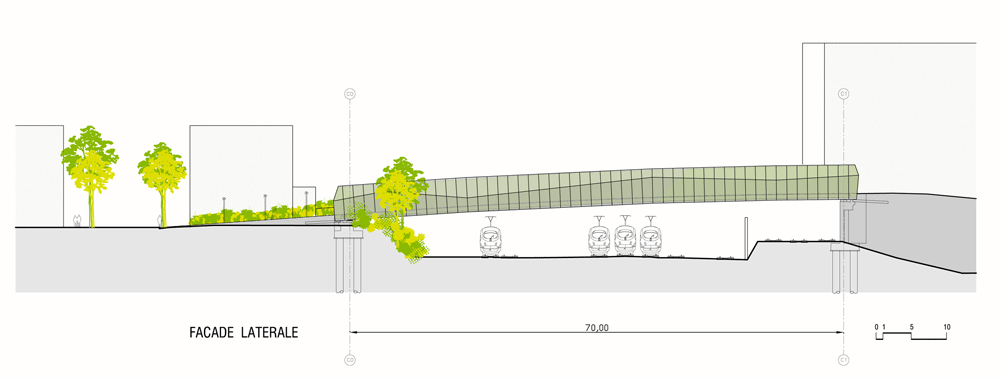
The seventy metres long Choisy-le-Roi bridge connects a recently redeveloped port district to the town centre.
Choisy-le-Roi bridge by Jacques Ferrier Architectures
By designing the bridge without requiring intermediate ground support it could be constructed over the railway line with minimal disruption to the train services.
Choisy-le-Roi bridge by Jacques Ferrier Architectures
The appearance of the bridge was inspired by The Pont Neuf Wrapped by Christo and Jeanne-Claude.
Choisy-le-Roi bridge by Jacques Ferrier Architectures
Photos are by Jacques Ferrier Architectures/Luc Boegly.
Here’s more from the architects:
New bridge in Choisy-le-Roi

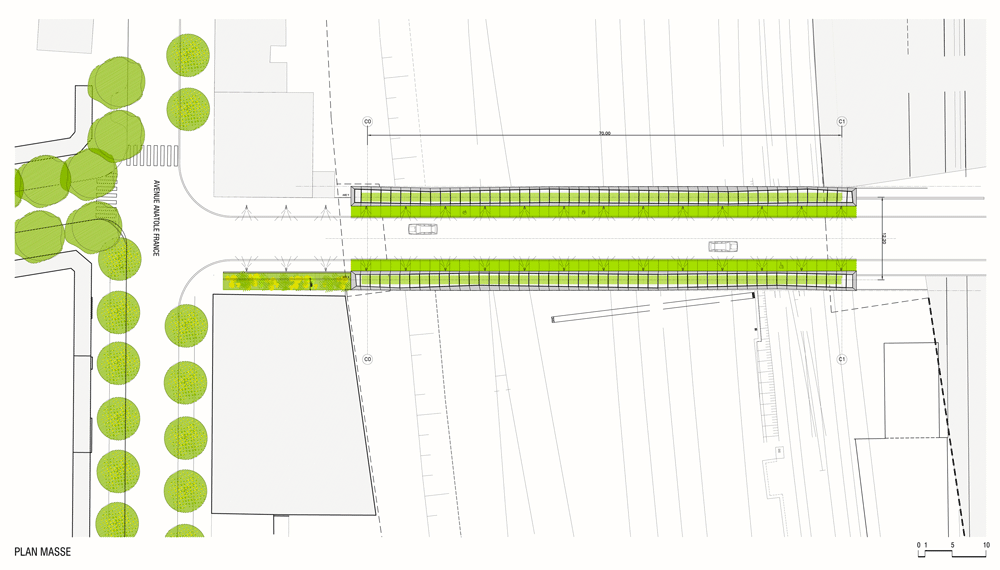
The new Choisy-le-Roi bridge crosses the RER C suburban express railway lines serving passenger traffic to and from the southern Paris region. The 70 m long bridge has a traffic lane in each direction contained within wide footpaths to either side.
Choisy-le-Roi bridge by Jacques Ferrier Architectures
Connecting the recently rehabilitated Port district with its housing, amenities, offices and Imprimerie Nationale workshops as well as Avenue Anatole France to the town centre, the bridge is an essential element in guaranteeing the success of this new district which, until now, has been cut off from the city due to its location between the railway lines and the River Seine.
Choisy-le-Roi bridge by Jacques Ferrier Architectures
The need for uninterrupted traffic flow – with the exception of a two hour break at night – represented the point of departure for the project’s technical and architectural design. It resulted in the bridge being designed as a straight double beam preassembled on one side of the railway lines which was then pushed out over the tracks in two operations, a solution that ensured that the overall span did not require any intermediate supports.
Choisy-le-Roi bridge by Jacques Ferrier Architectures
The infrastructure is contained within in a silvered perforated aluminium grid. This cladding, inspired by the wrapping of the Pont Neuf bridge by Christo and Jeanne-Claude, creates a memorable and poetic image without in any way interfering with the specifically technical aspects of the construction.
Choisy-le-Roi bridge by Jacques Ferrier Architectures
The grid creates a pleat that provides the bridge with a fabric-like sensuality while simultaneously revealing the presence of the structure. This aspect is further emphasised by the green colour that is used, especially successful when lit up at night. The result is that the grid offers a highly distinctive atmosphere when crossing the bridge by car or on foot. The pleat envelops the structure, protecting, surrounding and framing the views at either end.
Choisy-le-Roi bridge by Jacques Ferrier Architectures
The bridge presents itself as a uniting object, whether seen from above or from a distance. Its unambiguous technology provides a highly visible expression of the link created over the railway tracks and leading into the city.
Choisy-le-Roi bridge by Jacques Ferrier Architectures

It is an approach that also places emphasis on the “poetry of useful objects”, a way of inserting itself into the city that avoids any need for formal gestures.


The bridge presents itself as an icon, an efficient yet familiar object able to play a vital role in this rapidly changing urban environment.


Project data
Architectural team: Jacques Ferrier Architectures
Architect: Jacques Ferrier
Project Manager: Stéphane Vigoureux
Team: Katrin Wagner (project leader), Corentin Lespagnol (image conception), Léa Duverge, Harold Chaveneau
Design and construction with : Eiffage TP, Eiffel et Secoa


Client: Sadev94
City: Choisy-le-Roi
Competition: September 2008
Completion: May 2010
Area: 70 m long
Cost : 6.1 M Euros


--> Read more...

Lille Métropole Musée extension.

Lille Metropole Musee extension by Manuelle Gautrand
French architect Manuelle Gautrand has completed an extension to the Lille Métropole Musée d’art moderne, d’art contemporain et d’art brut at Villeneuve d’Ascq in France.
Lille Metropole Musee extension by Manuelle Gautrand
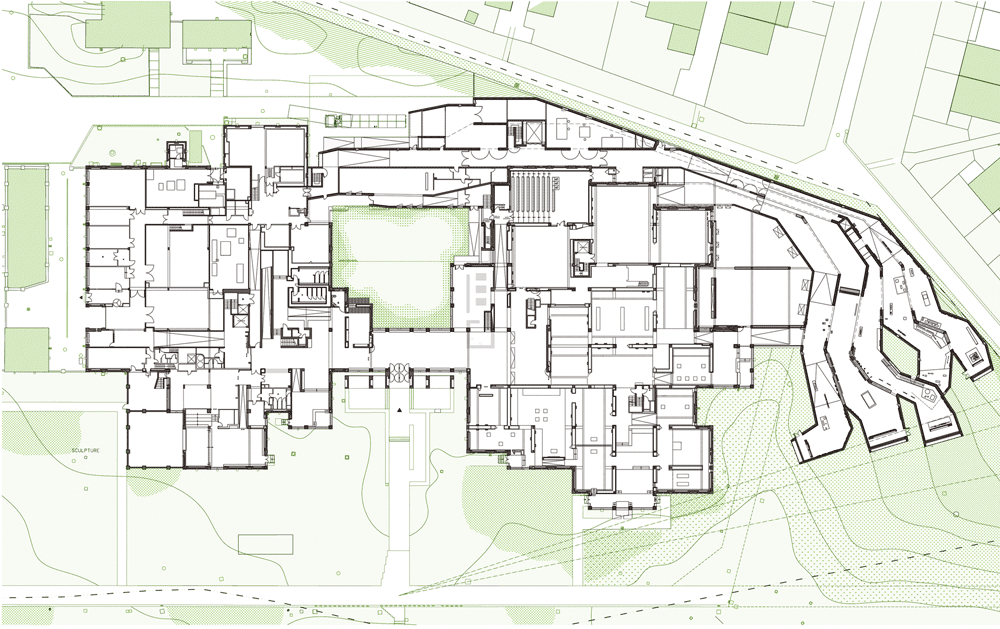
The project comprises five snaking volumes wrapped around the north and east sides of the existing building, which was originally designed in 1983.
Lille Metropole Musee extension by Manuelle Gautrand
Above photo by Vincent Fillon
On the north side these “ribs” house a restaurant opening onto a central patio, before fanning out on the east side to accommodate five galleries showing European art brut.
Lille Metropole Musee extension by Manuelle Gautrand
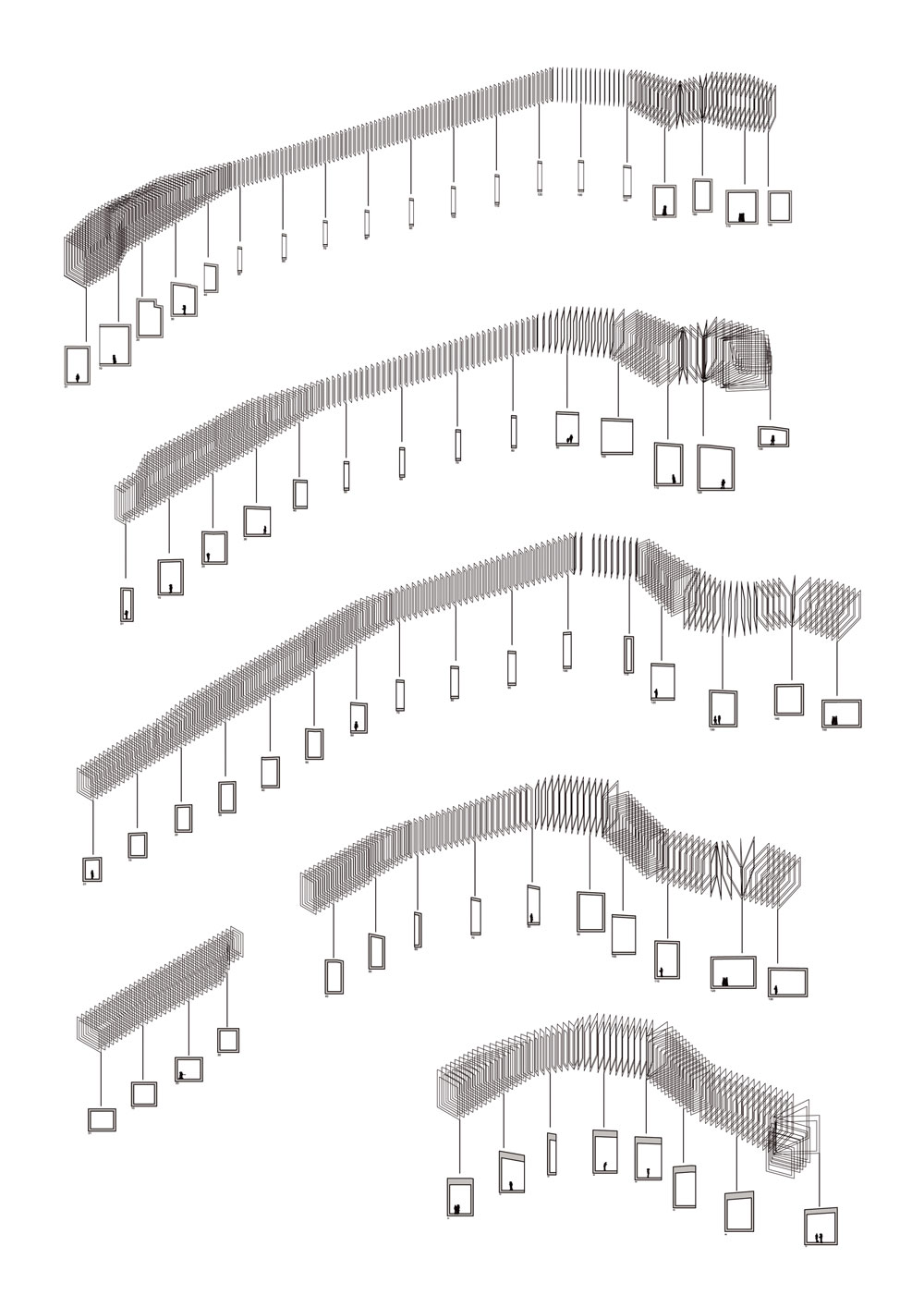
The new structure is punctured with an irregular pattern to restrict light levels within the galleries while affording views of the surrounding park at the end of each corridor.
Lille Metropole Musee extension by Manuelle Gautrand
This perforated design is repeated on display stands inside.
Lille Metropole Musee extension by Manuelle Gautrand
Photographs are by Max Lerouge except where stated otherwise.
Lille Metropole Musee extension by Manuelle Gautrand
The following information is from Manuelle Gautrand:

The project concerns the refurbishment and the extension of the Lille Modern Art Museum in a magnificent park at Villeneuve d’Ascq. The existing building, designed by Roland Simounet in 1983, is already on the Historic monuments list.
Lille Metropole Musee extension by Manuelle Gautrand
Above photo by Philippe Ruault
The project aims at building up the museum as a continuous and fluid entity, this by adding new galleries dedicated to a collection of Art Brut works, from a travelling movement that extrapolates existing spaces. A complete refurbishment of the existing building was next required, some parts were very worn.
Lille Metropole Musee extension by Manuelle Gautrand
In spite of the heritage monument status of Simounet’s construction, rather than set up at a distance, we immediately opted to seek contact by which the extension would embrace the existing buildings in a supporting movement.
Lille Metropole Musee extension by Manuelle Gautrand
I tried to take my cue from Roland Simounet’s architecture, ‘to learn to understand’, so as to be able to develop a project that does not mark aloofness, an attitude that might have been seen as indifference.
Lille Metropole Musee extension by Manuelle Gautrand
The architecture of the extension wraps around the north and east sides of the existing arrangement in a fan-splay of long, fluid and organic volumes. On one side, the fan ribs stretch in close folds to shelter a café-restaurant that opens to the central patio; on the other, the ribs are more widely spaced to form the five galleries for the Art brut collection.
Lille Metropole Musee extension by Manuelle Gautrand
The Art brut galleries maintain a strong link with the surrounding scenery, but they are also purpose-designed to suit the works that they house: atypical pieces, powerful works that you can’t just glance at in passing. The folds in these galleries make the space less rigid and more organic, so that visitors discover art works in a gradual movement.
Lille Metropole Musee extension by Manuelle Gautrand
The architecture is partly introverted, to protect art works that are often fragile and that demand toned down half-light.
Lille Metropole Musee extension by Manuelle Gautrand
At the extremity of the folds – meaning the galleries – a large bay opens magnificent views onto the surrounding parkland, adding breathing space to the visit itinerary. These views make up for the half-light in the galleries: the openwork screens in front of the bays mediate with strong light and parkland scenery, a feature that recalls Simounet’s generous arrangements in the galleries that he designed.
Lille Metropole Musee extension by Manuelle Gautrand
Envelopes are sober: smooth untreated concrete, with mouldings and openwork screens to protect the bays from too much daylight. The surface concrete has a slight colour tint that varies according to intensity of light.
Lille Metropole Musee extension by Manuelle Gautrand
Click for larger image
Lille Metropole Musee extension by Manuelle Gautrand
Click for larger image
Lille Metropole Musee extension by Manuelle Gautrand


.
--> Read more...

Pierres Vives. Zaha Hadid.

The Pierres Vives building of the department de l’Herault is characterised by the unification of three institutions – the archive, the library and the sports department – within a single envelope. 
 

Pierres Vives by Zaha Hadid

Pierres Vives by Zaha Hadid
Spatial Organisation
The main vehicular access road- both for public visitors as well as for staff and service vehicles, is coming off Rue Marius Petipa, and provides access to either side of the building. The public access leads to the generous visitor car park right in front of the main entrance lobby. The service access is stretched along the opposite side.
Pierres Vives by Zaha Hadid 

These various parts of this “cite administrative” combine into a strong figure visible far into the landscape. As one moves closer, the division into three parts becomes apparent. The building has been developed on the basis of a rigorous pursuit of functional and economic logic. However, the resultant figure is reminiscent of a large tree- trunk, laid horizontal.
Photography is by Hélène Binet.
 
This longitudinal division of serviced and servicing spaces is maintained within the ground floor along the full length of the building. The front side contains all the public functions of each institution, linked by a linear lobby and an exhibition space in the centre. Above this connective ground level the three institutions remain strictly separated. Each has its own set of cores for internal vertical circulation. The lay-outs of each part follow their specific functional logic.
Pierres Vives by Zaha Hadid
Upon arrival at the main entrance, one is directed from the lobby either to the educational spaces of the archives on ground level; or via lifts and escalators to the main public artery on level 1. 

 The archive is located at the solid base of the trunk, followed by the slightly more porous library with the sports department and its well-lit offices on top where the trunk bifurcates and becomes much lighter. The branches projecting off the main trunk are articulating the points of access and the entrances into the various institutions. On the western side all the public entrances are located, with the main entrance under an enormous cantilevering canopy; while on the eastern side all the service entrances, i.e. staff entrances and loading bays are located. In this way the tree-trunk analogy is exploited to organise and articulate the complexity of the overall “cite administrative”.

Pierres Vives by Zaha Hadid
The Pierres Vives Building will accommodate the multimedia library, public archive and sports department of the Herault regional government and is due to be inaugurated on 13 September.
Pierres Vives by Zaha Hadid
A recessed section of green-tinted glass runs along the length of the facade, where a first-floor foyer connects the library and offices with shared facilities that include meeting rooms, an auditorium and an exhibition space.

These shared facilities are contained inside a curved concrete block, which bursts through the glazing to shelter the main entrance on the ground floor below.
Pierres Vives by Zaha Hadid
Zaha Hadid has also been in the news recently over claims she was to blame for tickets sold at the Olympic Aquatics Centre for seats with restricted views.
Pierres Vives by Zaha Hadid 


Pierres Vives by Zaha Hadid

This artery is articulated all along the facades as a recessed glass strip and here reading rooms of both archives and library are immediately accessible. Central in this artery and therefore located at the heart of the building, are the main public facilities shared between the three institutions: auditorium and meeting rooms. These shared public functions also form the central volume that projects out from the trunk, providing a grand cantilevering canopy for arriving visitors.

Pierres Vives by Zaha Hadid
Project: Pierres Vives
Location: Montpellier, France
Date: 2002 / 2012
Client: Departement de l’Herault
Size: 35,000 m2

Architectural Design: Zaha Hadid
Project Architect: Stephane Hof

Local Architect:
Design Phase: Blue Tango
Execution Phase: Chabanne et Partenaires

Structure: Ove Arup & Partners
Services: Ove Arup & Partners (Concept Design) & GEC Ingenierie

Acoustics: Rouch Acoustique Nicolas Albaric
Cost: Gec LR, Ivica Knezovic
--> Read more...

Alésia Museum visitor’s centre.

Alésia Museum visitor’s centre. Bernard Tschumi Architects


Alésia Museum Visitor Centre by Bernard Tschumi Architects

The cylindrical centre occupies the same position held by the Roman army during a historic battle against the Gauls over 2000 years ago and its wooden exterior references the timber fortifications that would have been constructed nearby.

Alésia Museum Visitor Centre by Bernard Tschumi Architects
A second museum building, contrastingly clad in stone, is also being constructed a kilometre away across the battlefield and the pair will together comprise the Alésia Museum complex.

Exhibitions inside the visitor’s centre will portray the events of the battle and its aftermath, while the second building will present artefacts unearthed from the site.
Alésia Museum Visitor Centre by Bernard Tschumi Architects
A garden of grass and trees covers the roof of the visitor’s centre and will be accessible to visitors.

Alésia Museum Visitor Centre by Bernard Tschumi Architects


Photography above is by Christian Richters, while photography below is by Iwan Baan.

Alésia Museum Visitor Centre by Bernard Tschumi Architects
The roof of the building is planted with low shrubs and trees, so as to minimize the visual impact of the building when seen from the hill above (the historical position of the Gauls).
Alésia Museum Visitor Centre by Bernard Tschumi Architects


The materiality and sustainable elements of the building are meant to make visitors aware of the surrounding landscape, which appears much as it would have 2000 years ago.
Alésia Museum Visitor Centre by Bernard Tschumi Architects
A second building on the hill will mark the location of the Gauls, and has a similar geometry, but is clad in stone, evoking its trenched position.
Alésia Museum Visitor Centre by Bernard Tschumi Architects
The interpretive center will contain exhibits and interactive displays that contextualize the events of the Battle of Alésia and its aftermath.
Alésia Museum Visitor Centre by Bernard Tschumi Architects

The displays are intended to reach a broader audience than a museum, with a range of media and programs for all ages.
Alésia Museum Visitor Centre by Bernard Tschumi Architects
The second building will act as a more traditional museum, with a focus on found objects and artifacts unearthed from the site. The second building is scheduled to be completed in 2015.
--> Read more...

Most seen published projects.